Employee Scheduling Software Feature Audit for Multi-Location Businesses
Updated October 2026 · Buying frameworks, vendor fit and real decision criteria
Multi-location workforce software should be purchased against shift exceptions and payroll outcomes, not a generic calendar checklist.
Software to evaluate: five real options
These are qualitative shortlists, not ranked review scores or confirmed pricing quotes. Verify each product’s current plans and technical capabilities before purchase.
Deputy
Best-fit evaluation: Shift-oriented, multi-location teams
Why shortlist it: Its positioning makes it a useful candidate for shift-oriented, multi-location teams. Request a live workflow demonstration rather than relying on a feature checklist.
Key buying tradeoff: Local rule and payroll configuration. Verify current availability, included modules, support level, and plan pricing in writing.
When I Work
Best-fit evaluation: Hourly teams seeking easy adoption
Why shortlist it: Its positioning makes it a useful candidate for hourly teams seeking easy adoption. Request a live workflow demonstration rather than relying on a feature checklist.
Key buying tradeoff: Permission/reporting requirements. Verify current availability, included modules, support level, and plan pricing in writing.
Why shortlist it: Its positioning makes it a useful candidate for restaurant scheduling operations. Request a live workflow demonstration rather than relying on a feature checklist.
Key buying tradeoff: POS labor reporting requirements. Verify current availability, included modules, support level, and plan pricing in writing.
Homebase
Best-fit evaluation: Small businesses with hourly staff
Why shortlist it: Its positioning makes it a useful candidate for small businesses with hourly staff. Request a live workflow demonstration rather than relying on a feature checklist.
Key buying tradeoff: Per-location and payroll plan limits. Verify current availability, included modules, support level, and plan pricing in writing.
Connecteam
Best-fit evaluation: Mobile-first frontline teams
Why shortlist it: Its positioning makes it a useful candidate for mobile-first frontline teams. Request a live workflow demonstration rather than relying on a feature checklist.
Key buying tradeoff: Scheduling module and attendance needs. Verify current availability, included modules, support level, and plan pricing in writing.
Compare fit and purchasing risks
Vendor
Best evaluation fit
Validate before buying
Deputy
Shift-oriented, multi-location teams
Local rule and payroll configuration
When I Work
Hourly teams seeking easy adoption
Permission/reporting requirements
7shifts
Restaurant scheduling operations
POS labor reporting requirements
Homebase
Small businesses with hourly staff
Per-location and payroll plan limits
Connecteam
Mobile-first frontline teams
Scheduling module and attendance needs
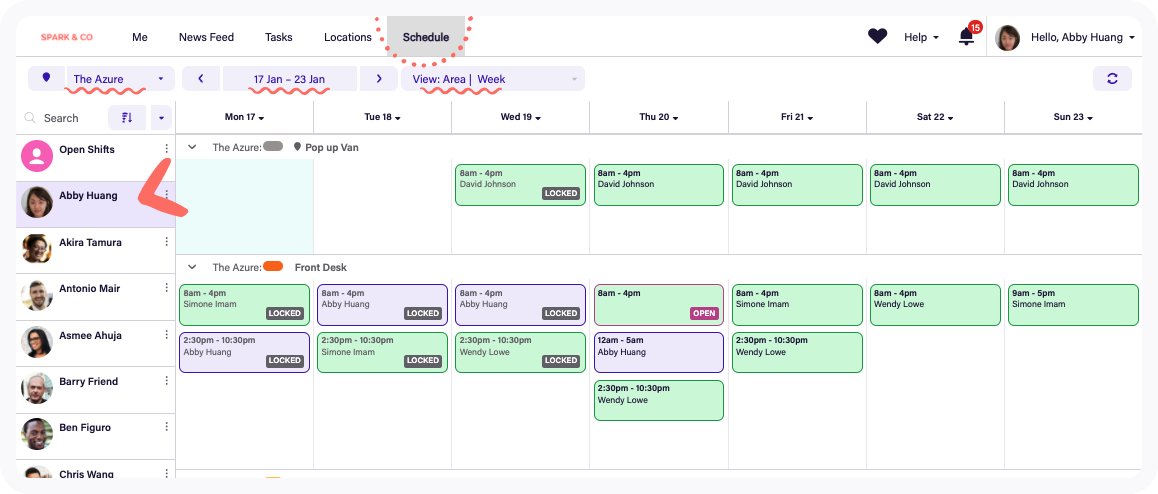
Example product interface from Verwick’s media library. Verify current screens during a vendor demonstration.
Which tool should you shortlist?
Small retailer: test mobile accessibility and a simple weekly schedule.
Multi-location operator: require cross-store assignment and location-level manager permissions.
Restaurant: include role coverage, POS-linked labor reporting and last-minute callouts.
Worked example: use the same test across vendors
Pilot scenario: one employee is unavailable, a qualified colleague from another location swaps in, overtime is near the threshold, and a manager approves the change. Score the manager workflow, worker notifications, payroll results and permission boundaries.
Vendor demo and procurement questions
Can cross-location staff be scheduled without duplicated employee accounts?
Can every manager see only authorized employees and locations?
Can time, breaks and overtime flow accurately to payroll?
Which labor-law settings are configurable and who maintains them?
How to make a defensible purchase
First, separate non-negotiable workflows from nice-to-have features. Second, ask vendors to demonstrate the same scenario using realistic records. Third, request the complete contract costs—including onboarding, migration, integrations, volume limits, staff training and support. Finally, record what the vendor actually demonstrated and what was only described on a sales call.
Avoid false precision: product packaging and prices change; no current price is asserted here unless directly quoted from a verifiable vendor source. Use the table as a requirements-based shortlist and obtain current proposals before selecting a provider.
Need a narrower shortlist?
Compare candidates in Verwick and tell us which workflows matter most.