Best Nonprofit CRM Software for 2026
Compare nonprofit CRM platforms for donor management, fundraising, communications, events, reporting and supporter engagement—from accessible systems for growing organizations to more sophisticated fundraising platforms.
Nonprofit CRM software compared
| Software | Strong use case | Primary emphasis |
|---|---|---|
| Bloomerang | Small and midsize fundraising teams | Donor management, engagement and retention |
| Neon CRM | Growing nonprofits wanting a connected platform | Donors, fundraising, communications, events and memberships |
| DonorPerfect | Established fundraising organizations | Donor records, fundraising workflows and reporting |
| Givebutter | Organizations emphasizing digital fundraising | Fundraising, campaigns, donor engagement and CRM |
| Salesforce Nonprofit Cloud | Organizations needing a highly extensible ecosystem | Constituent data, fundraising and configurable workflows |
| Little Green Light | Smaller nonprofits prioritizing simplicity and cost | Donor management and fundraising administration |
Bloomerang
Bloomerang is purpose-built for nonprofit fundraising teams and centers the CRM experience around donor records, engagement and fundraising activity. It is particularly relevant to organizations replacing spreadsheets or disconnected fundraising tools with a system designed around the donor lifecycle.
Neon CRM
Neon CRM brings donor management, fundraising, communications and reporting into a unified supporter record, with optional capabilities around events, memberships and volunteers. Neon One currently lists Neon CRM starting at $99 per month and positions it for small and midsize nonprofits.
DonorPerfect
DonorPerfect is a longstanding nonprofit fundraising CRM oriented around constituent records, gift tracking, communications and reporting. It belongs on shortlists where development teams want mature fundraising workflows and a system focused more specifically on donor administration than a general-purpose sales CRM.
Givebutter
Givebutter approaches the nonprofit CRM from a fundraising-first direction. It is relevant to organizations running online campaigns, donation forms and supporter communications that want donor activity flowing into the same relationship-management environment.
Salesforce Nonprofit Cloud
Salesforce Nonprofit Cloud is suited to nonprofits that need extensibility across constituent management, fundraising and organizational workflows. Its flexibility can be valuable for complex organizations, but buyers should evaluate implementation, administration and customization requirements alongside the software itself.
Little Green Light
Little Green Light is commonly evaluated by smaller nonprofits looking for donor and fundraising administration without a large enterprise implementation. Its narrower scope can be an advantage when a team primarily needs a reliable constituent database, gift tracking and everyday development workflows.
How to choose nonprofit CRM software
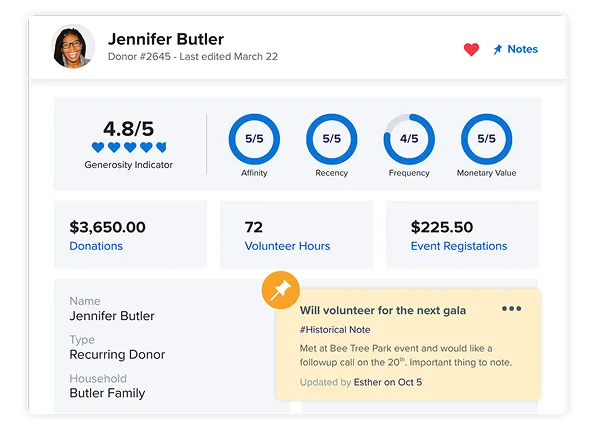
Start by defining which relationships the CRM must represent. Donors may be only one part of the picture: many nonprofits also need to understand households, members, volunteers, event attendees, recurring supporters, major-gift prospects and organizational contacts.
Then map the fundraising workflow from acquisition through stewardship. Evaluate donation and pledge tracking, recurring gifts, segmentation, acknowledgments, email and texting, campaign reporting, events, memberships, volunteer data, accounting integrations, permissions and data import. Migration quality is especially important because historical donor data is often one of a nonprofit’s most valuable operational assets.
Nonprofit CRM features worth evaluating
- Constituent and household records
- Donation, pledge and recurring-gift tracking
- Fundraising campaigns and online forms
- Segmentation and donor communications
- Automated acknowledgments and workflows
- Event, membership and volunteer capabilities
- Dashboards and fundraising reports
- Accounting and payment integrations
- Data import, deduplication and export
- Role-based permissions and security
Frequently asked questions
What is a nonprofit CRM?
A nonprofit CRM is a constituent relationship management system that centralizes relationships with donors and other supporters. Unlike a typical sales CRM, nonprofit systems commonly include donation history, fundraising campaigns, pledges, acknowledgments and supporter engagement data.
What is the difference between nonprofit CRM and donor management software?
Donor management software can focus narrowly on gifts and donor records. A nonprofit CRM may cover a wider relationship picture that includes donors, volunteers, members, event attendees, communications and fundraising activity.
Can a small nonprofit use a CRM?
Yes. Smaller organizations often benefit when spreadsheets begin creating duplicate records, missed follow-ups or fragmented donation histories. The important question is whether the system is simple enough for the team to maintain consistently.
What should nonprofits plan before migrating CRM systems?
Inventory existing databases and spreadsheets, decide which historical data should move, establish duplicate and household rules, map custom fields and test donation and reporting workflows before the final migration.
Should fundraising tools and the CRM be integrated?
Usually. When donation forms, payment systems, email tools and event platforms feed the CRM automatically, teams can reduce manual entry and build a more complete supporter history.
Research note: Product capabilities and positioning were reviewed against current vendor information in October 2026. Pricing and packaging can change; verify final pricing and implementation requirements directly with each vendor.